
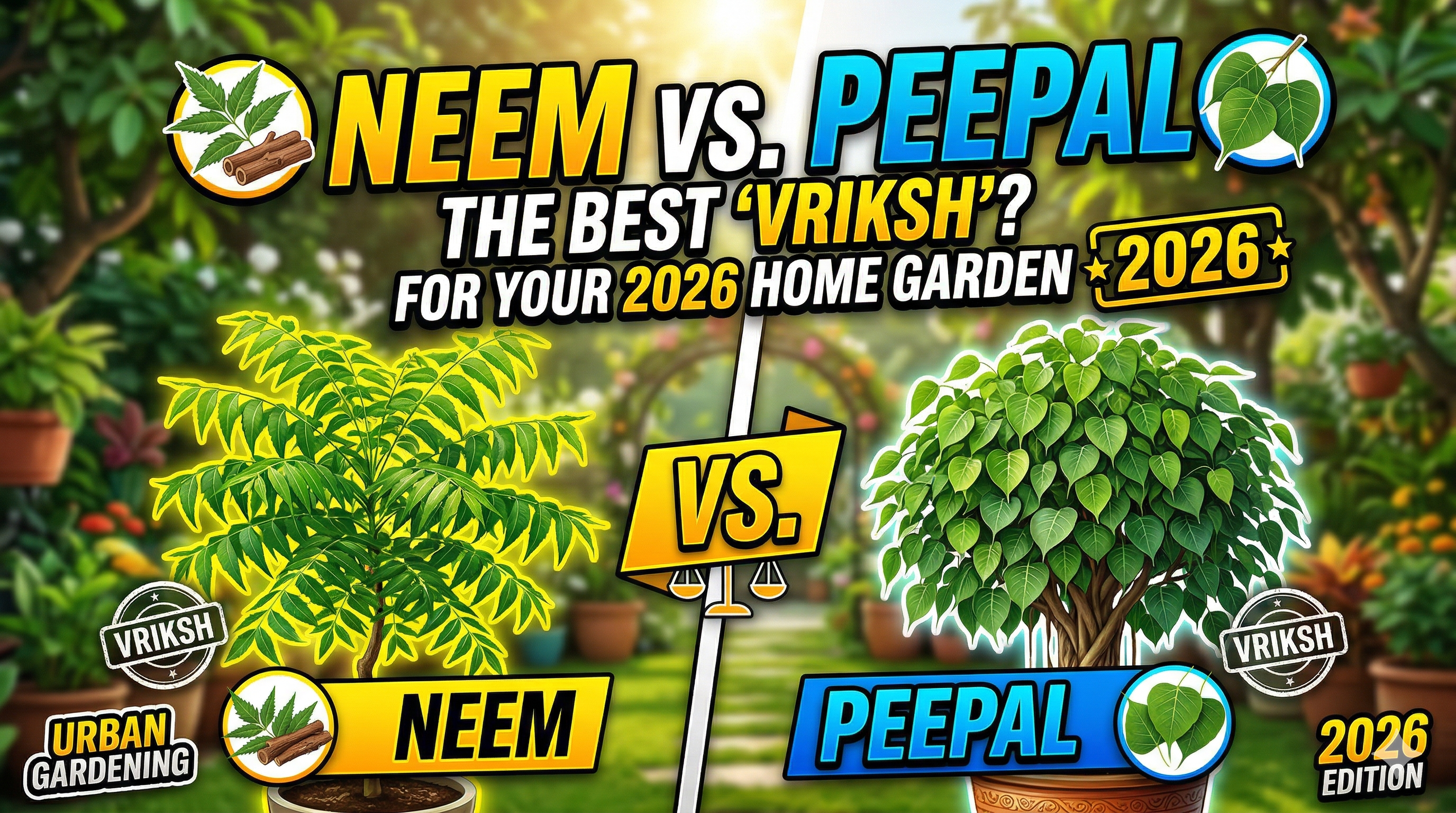
Neem vs. Peepal: The Best 'Vriksh' for Your 2026 Home Garden
“Neem or Peepal? Discover which sacred tree is best for your Indian garden in 2026 based on air purification, cooling, and balcony-friendly tips.”
Which tree is better for an Indian home: Neem or Peepal?
For most Indian urban homes in 2026, the Neem tree is the superior choice for home gardens and balconies because of its natural pest-repellent properties and manageable size, while the Peepal tree is unmatched for air purification but requires significant space. If you are living in a flat in Surat or Mumbai, a Neem tree in a large pot is a practical 'green tree' solution, whereas the Peepal is best kept as a Bonsai tree to protect your building's foundation from its aggressive roots.
As the March 2026 heatwaves intensify, the search for the perfect vriksh (tree) has shifted from purely aesthetic plants to those that offer functional 'environmental gain.' Data from Google Trends shows a massive 100% surge in 'natural cooling' solutions, with the Neem tree and Peepal tree leading the charts. In a year where urban heat islands are making city life difficult, choosing a big tree with high transpiration rates is no longer a luxury—it is a necessity for a cool, breathable home.

Q. The Neem Tree: India’s 'Village Pharmacy' in a Pot
The Neem tree (Azadirachta indica) is perhaps the most versatile vriksh for the modern Indian gardener. Unlike the national tree of India (the Banyan), which can take over an entire block, the Neem is surprisingly adaptable to container gardening. In 2026, many Surat residents are successfully growing Neem on their balconies to act as a biological shield against pests and heat.
- Natural Pest Control: The presence of a Neem tree naturally reduces the population of mosquitoes and aphids. Its leaves release organic compounds that disrupt the life cycle of common garden pests, protecting your indoor plants from yellowing and infestations.
- Cooling Power: Neem has a high 'Leaf Area Index' (LAI), meaning its dense, feathery foliage provides excellent dappled shade, reducing the land surface temperature of your balcony by up to 4°C.
- Medicinal Value: Having fresh Neem leaves available is a staple of Indian household wellness, used in everything from skincare to organic fertilizers.
Q. The Peepal Tree: The 24-Hour Oxygen Machine
The Peepal tree (Ficus religiosa), also known as the 'Sacred Fig,' holds a unique biological advantage that is driving its popularity in 2026: it is one of the few trees that performs Crassulacean Acid Metabolism (CAM)-like behavior, releasing oxygen even at night. This makes it a powerhouse for air purification in polluted cities like Mumbai.
Technical Deep Dive: The Foundation Risk vs. Oxygen Gain
While the Peepal is a green tree marvel, its root system is incredibly invasive. In nature, Peepal seeds often germinate in the cracks of buildings, and their roots can exert enough pressure to split concrete. This is why, in 2026, we strictly recommend the Peepal Bonsai for urban dwellers. A Bonsai tree allows you to enjoy the spiritual and air-purifying benefits of the Peepal without risking the structural integrity of your home. The restricted root environment of a ceramic pot prevents the tree from becoming a 'foundation-breaker' while maintaining its 24-hour oxygen-release cycle.

Q. Pro-Tip: The 'Drip-Tray' Cooling Method
To maximize the cooling effect of your tree plantation on a hot Surat balcony, use deep drip trays (5-10 cm). Fill the tray with pebbles and keep it filled with water. As the sun hits the tray, the water evaporates around the base of your Neem or Palm tree, creating a humid micro-climate that prevents 'leaf scorch.' This simple trick can prevent the dreaded yellow leaves caused by extreme dry heat, keeping your vriksh vibrant even in 45°C weather.
Q. Soil pH and Urban Water Challenges
Whether you are planting a Mango tree, a Coconut tree, or a Neem tree, the soil pH in 2026 urban India is a major hurdle. Most tap water in our cities is slightly alkaline (pH 7.5+), which can cause nutrient lockout. For a healthy green tree, aim for a pH of 6.5. You can achieve this by adding Neem cake powder to your soil mix—it acts as both a slow-release fertilizer and a pH stabilizer. If your tree photo shows pale, stunted growth, it’s time to test your soil and adjust the acidity.
Q. The 'Tree of Life' in Your Backyard
The Banyan tree, our national tree of India, and the Peepal are often grouped together in Indian culture as the 'Tree of Life.' While they are spiritually significant, their role in 2026 is becoming increasingly scientific. We are seeing a shift where 'Vriksh' is no longer just a religious symbol but a key component of 'Climate-Responsive Design.' By planting even one big tree in your community or one Bonsai tree on your balcony, you are participating in a nationwide movement to 'Save Trees' and lower the urban thermometer.

Q. Summary: Choosing Your Green Companion
If you have limited space and want a hard-working, pest-repelling plant, the Neem tree is your best bet for 2026. If you have a larger garden or want to master the art of the Bonsai tree, the Peepal offers unmatched air quality benefits. Both trees represent the best of Indian horticulture. Remember, successful tree plantation starts with the right pot and the right soil pH. Don't wait for the April heat to peak—get your vriksh into the ground (or the pot) today to ensure a cooler, greener tomorrow.
Ready to start? Grab a Neem sapling this weekend and give your balcony the upgrade it deserves!